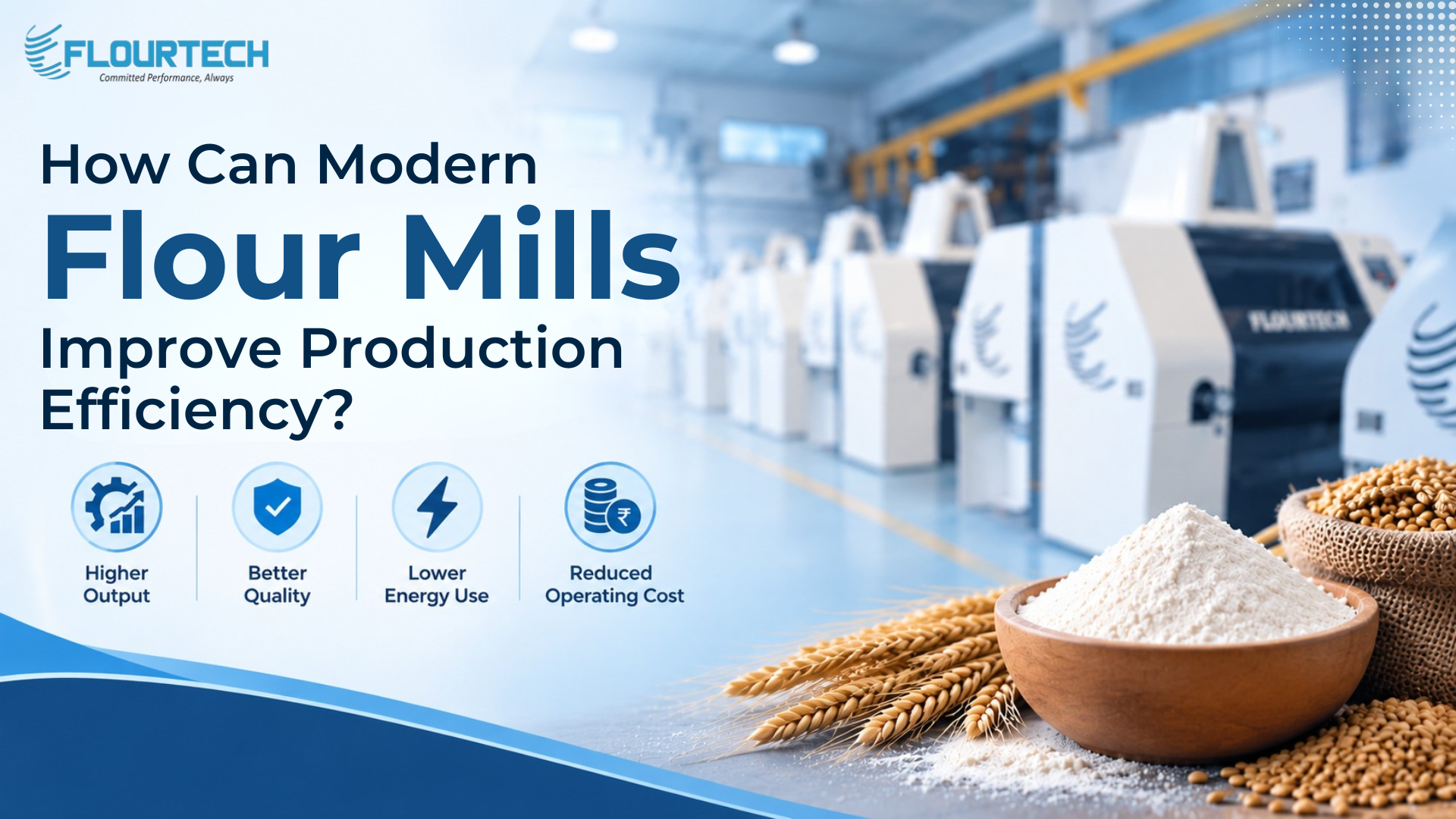
A flour mill can produce thousands of tonnes of flour, but the real measure of a good milling operation is not only how much it produces. It is how consistently it produces, how much usable flour it recovers from the wheat, how efficiently it uses energy, and how often production is interrupted.
This is where modern flour mills are changing the way they approach production.
Instead of looking at individual machines in isolation, millers are paying more attention to the complete process. Wheat quality, cleaning, conditioning, grinding, sifting, material movement, automation, and maintenance are all connected. When one part of the process is not performing properly, it can affect everything that follows.
So, improving flour mill production efficiency is less about simply running machines faster and more about making the entire milling process work better together.
Why Is Production Efficiency Becoming More Important?
Flour milling is a continuous process, and even small inefficiencies can become significant over time.
A blockage that takes a few minutes to clear, inconsistent wheat moisture, a worn roller, inefficient conveying, or repeated reprocessing may not seem like a major issue on its own. But when these problems happen regularly, they can reduce daily output and increase operating costs.
At the same time, millers need to maintain consistent flour quality. Customers expect the flour to perform consistently from one batch to another, whether it is being used for bakery products, biscuits, atta, or other applications.
This means a modern flour mill has to balance several objectives at once:
- Maintain consistent production
- Achieve the required extraction rate
- Maintain flour quality
- Reduce unnecessary downtime
- Control energy consumption
- Keep machinery operating reliably
- Minimize product losses and reprocessing
The key is to improve efficiency without compromising the quality of the final product.
Start With the Wheat, Not the Roller Mill
One of the easiest mistakes in flour milling is to focus heavily on the milling section while overlooking what happens before the wheat reaches it.
Wheat arrives with different levels of impurities depending on its source and handling conditions. Dust, stones, foreign particles, metal contamination, and other materials need to be removed before the grain enters the main milling process. An effective cleaning section can include equipment such as pre-cleaners, destoners, vibro separators, drum sieves, magnetic separators, scourers, and other specialized cleaning systems. Each machine has a specific role, but the important point is how these machines work together.
Better cleaning does more than improve the appearance of the grain. It helps protect downstream equipment, prepares the wheat for conditioning, and provides a more suitable raw material for the milling process.
For modern flour mills, the cleaning section should therefore be considered an important part of overall production efficiency rather than simply a preliminary step.
Get Wheat Conditioning Right
Once the wheat has been cleaned, its preparation continues through conditioning.
The condition of wheat entering the milling section can influence how effectively the bran and endosperm separate. Moisture addition needs to be controlled according to the characteristics of the wheat and the requirements of the process.
Inconsistent dampening can create variations in milling performance. Too little or too much moisture can affect the way the grain behaves during grinding and separation. Modern flour mills can use automatic dampening and moisture control systems to make this process more consistent.
The benefit is not simply automation itself. Better control means the wheat entering the milling section is more predictable, which can help the mill maintain stable operating conditions.
Think About the Complete Milling Process
Once wheat enters the milling section, the objective is to gradually break down the grain and separate the useful components efficiently. Modern roller milling systems allow the process to be controlled through a series of grinding and separation stages. But achieving good performance requires more than installing high-capacity equipment. Roller condition, roll surface, feeding, machine settings, and the relationship between different milling passages can all influence the final result.
For example, worn or improperly maintained roll bodies can affect grinding performance. Similarly, incorrect settings can increase unnecessary load and affect the quality of intermediate products.
This is why flour mill efficiency should be considered as a process rather than a single machine.
The question is not only, “How much can this machine produce?”
It is also, “How well does this machine perform as part of the complete milling system?”
Reduce Unnecessary Material Movement
A flour mill involves continuous movement of wheat and intermediate products.
After grinding, material may pass through sifters and return to different milling passages depending on its characteristics. Flour, bran, and other fractions need to reach their appropriate destinations without unnecessary delays.
If material flow is poorly planned, the result can be more handling, blockages, longer conveying distances, and unnecessary reprocessing. A properly designed material handling system can make a significant difference.
Bucket elevators, pneumatic conveying systems, sifters, and other equipment should be planned around the overall process flow. The objective is to create a logical movement of material through the plant while avoiding unnecessary transfers.
Good process design can therefore improve efficiency even before automation or advanced monitoring systems are considered.
Use Automation to Improve Control, Not Just to Reduce Labour
Automation is often associated with reducing manual work, but its value in modern flour mills goes further. A well-designed automation system can help operators monitor important process conditions and maintain more consistent control over the plant. Depending on the plant and its requirements, automation can support grain feeding, dampening, process control, product handling, alarms, and production monitoring. This gives operators better visibility into what is happening inside the mill.
For example, if a process parameter begins to move outside its normal range, operators can identify the change and investigate it before it develops into a larger production or quality issue. Automation can also make it easier to collect production data over time. This data can help millers understand trends, compare performance, and identify areas where the process can be improved.
The real value of automation is therefore not simply fewer people operating the plant. It is better process control.
Pay Attention to What the Data Is Saying
Modern flour mills have access to more production information than ever before. The challenge is knowing how to use it. Production data can reveal patterns that are difficult to notice during day-to-day operation.
For example, if energy consumption increases while production remains the same, it may be worth investigating equipment condition or process settings. If a particular section repeatedly causes delays, the problem may be related to material flow, machine performance, or maintenance.
Instead of looking only at daily production figures, millers can track a wider range of indicators such as:
- Production output
- Extraction rate
- Energy consumption
- Downtime
- Reprocessing
- Equipment performance
- Product quality
These measurements provide a clearer understanding of actual flour milling efficiency.
Prevent Small Equipment Problems From Becoming Big Ones
A flour mill depends on many machines working continuously. A problem in one critical piece of equipment can affect the entire production line. That is why maintenance should not begin only after a machine breaks down. Regular inspection of rollers, bearings, sifters, conveyors, pneumatic systems, and other important components can help identify early signs of wear.
For example, unusual vibration, changes in machine performance, excessive wear, or changes in energy consumption may indicate that equipment needs attention.
Preventive and condition-based maintenance can help mills reduce unexpected downtime and keep critical machinery available for production.
In a continuous production environment, avoiding an unexpected stoppage can be just as valuable as increasing machine capacity.
Improve Efficiency Without Chasing Maximum Output
There is a common assumption that the most efficient flour mill is the one producing the highest possible output.
In reality, maximum output and maximum efficiency are not always the same thing.
Pushing production too far can affect product quality, increase energy consumption, create additional stress on equipment, or result in more reprocessing. A better approach is to find the operating point where production, extraction, quality, energy use, and equipment performance are properly balanced. This is especially important when different types of flour are being produced. The ideal process conditions may change depending on the wheat and the desired flour specification.
Modern flour milling is therefore about controlled production, not simply maximum production.
Modernization Does Not Always Mean Replacing Everything
Improving an existing flour mill does not necessarily mean replacing every machine. Sometimes the biggest improvements can come from identifying where the current process is losing efficiency. A mill may benefit from improving wheat conditioning, upgrading a particular handling system, improving automation, modifying material flow, or introducing better monitoring and maintenance practices. Before making major investments, it is useful to understand where the actual bottlenecks are.
This approach can make modernization more practical because improvements are directed towards the areas that can deliver the greatest impact.
Building a More Efficient Flour Mill
The most efficient modern flour mills are not built around one technology. They are built around integration. Cleaning equipment needs to prepare wheat properly. Conditioning needs to provide consistent moisture. Milling machinery needs to operate under suitable conditions. Sifting and material handling need to maintain the correct flow. Automation needs to connect the process and provide useful information. Maintenance needs to keep critical equipment reliable. When these areas work together, the mill becomes easier to control and more predictable to operate.
This is where experienced flour mill engineering and plant design become important. A well-designed system considers not only individual machines but also how they interact with one another throughout the production process.
Conclusion
Improving production efficiency in modern flour mills is not about relying on a single machine or technology. It requires a well-connected approach where grain cleaning, wheat conditioning, milling machinery, material flow, automation, monitoring, and maintenance work together.
The right combination of process design, reliable flour milling machinery, and automation can help mills achieve consistent production, better resource utilization, reduced downtime, and improved overall performance.
With experience in designing and developing complete flour milling solutions, Flourtech Engineers focuses on combining the right technology and process approach to meet different production requirements.
Efficient flour milling is not simply about producing more. It is about getting better performance from every stage of the process.
Looking to Improve Your Flour Mill Efficiency?
A well-designed milling process can help improve production, consistency, and overall plant performance. Flourtech Engineers provides turnkey flour milling solutions designed around your production requirements.
Talk to our team to discuss your flour mill project.
Visit: www.flourtech.com
Call: +91 8826731010, +91-9663594709